Extension planning guide
Do I Need Planning Permission for an Extension?
Understanding permitted development rights for house extensions in the UK. What you can build without planning permission and when you need an application.
Typical budget range
£30,000–£120,000+
Main cost drivers
Size, specification, glazing, foundations
Best use
Feasibility before design spend
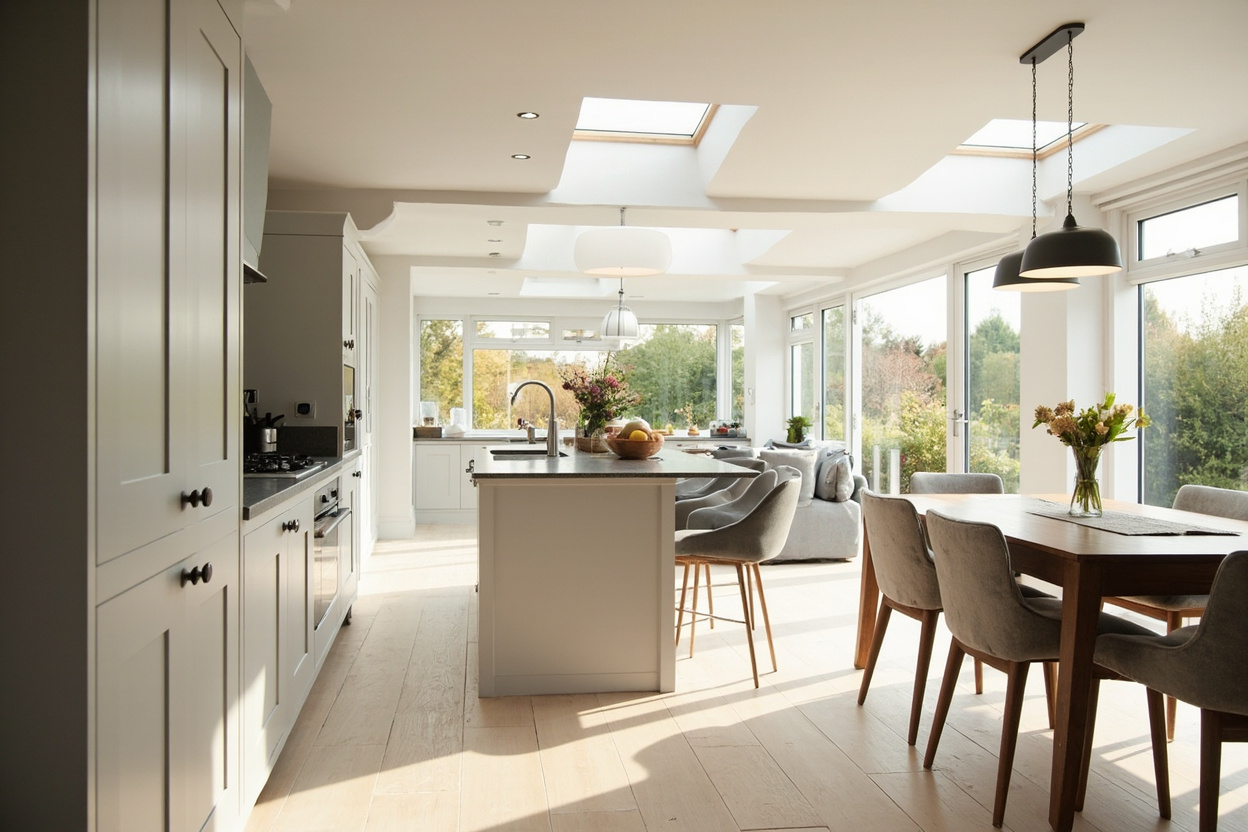
Extension example
The kind of rear extension result people picture — but the real budget is driven by structure, spec and ground conditions.
Extension guide snapshot
Per-m² figures help, but hidden build costs still matter
Foundations, steelwork, glazing packages and fit-out choices can swing the project far beyond the headline rate.
Remember
A crisp-looking extension budget can still be wrong if it ignores enabling works, drainage and finishing items.
Good next step
Use the extension calculator after reading to compare realistic size and spec combinations.
Permitted Development: What You Can Usually Build
Under the Town and Country Planning (General Permitted Development) (England) Order 2015 (as amended), many extensions can be built without a full planning application. The key limits for residential extensions:
Single Storey Rear Extensions
| Semi-detached / End-terrace | Up to 6m depth from original house rear wall |
| Detached house | Up to 8m depth from original house rear wall |
| All houses (from 2025) | Up to 9m if within 4m of a boundary |
Note: The 6m/8m limits are the default — they were temporarily extended to 6m/8m for detached houses from 2021 to 2025, and some local authorities have adopted different rules. Always verify with your local planning authority.
Double Storey Extensions
Double storey rear extensions on semi-detached or terraced houses almost always require planning permission because they are closer to the boundary at first-floor level and can affect neighbours' light significantly.
When Full Planning Permission Is Required
- Any extension that exceeds the permitted development limits (depth, height, proximity to boundary)
- Side extensions of more than one storey (single storey side extensions are usually permitted)
- Extensions within a conservation area (even single storey rear may need consent)
- Listed buildings (Listed Building Consent is always required, separate from planning)
- Extensions on flats or maisonettes (different permitted development rules apply)
- A property that has already used its PD rights (e.g., a previous rear extension)
- Extensions that would be visible from the road on a designated heritage asset
Prior Approval: A Faster Route
For larger single storey rear extensions that exceed the standard PD limits, you can use the Prior Approval process. This is faster than a full planning application:
- You notify the local authority of the proposed extension
- They consult with neighbours and the highway authority
- The focus is on neighbour notification and impact — not the principle of the extension
- Decision typically in 28 days (vs 8 weeks for full planning)
- Fees are lower: £206 for prior approval vs higher for full application
Other Considerations
- Building Regulations — always required, even if planning isn't. A separate building regulations application must be submitted.
- Party Wall Act — if building within 3m of a neighbour's property (or within 6m where the works affect their structure), you must serve a Party Wall Notice.
- Highway authority — if the extension extends to the front or side of the house and affects a public highway or pavement, additional approvals are needed.
- Article 4 Direction — some local authorities have removed permitted development rights in certain areas. Always check with your local planning authority.
How to Check Your PD Rights
The easiest route is to check with your local planning authority — either via their website or a pre-application advice meeting. Many now offer free or low-cost written confirmation of what you can do.
You can also use the planning portal's permitted development tool, but this is a general guide — always verify with your local authority for your specific property.
Calculate your extension cost
Get a budget estimate including design fees and contingency.
Open Extension Cost Calculator →