Project comparison
Extension vs Loft Conversion Cost
Compare extension vs loft conversion cost in the UK, including price per m², disruption, planning considerations and value added.
Main trade-off
Ground-floor space vs upstairs space
Budget lens
Total cost, disruption and value fit
Best use
Choosing where to add space
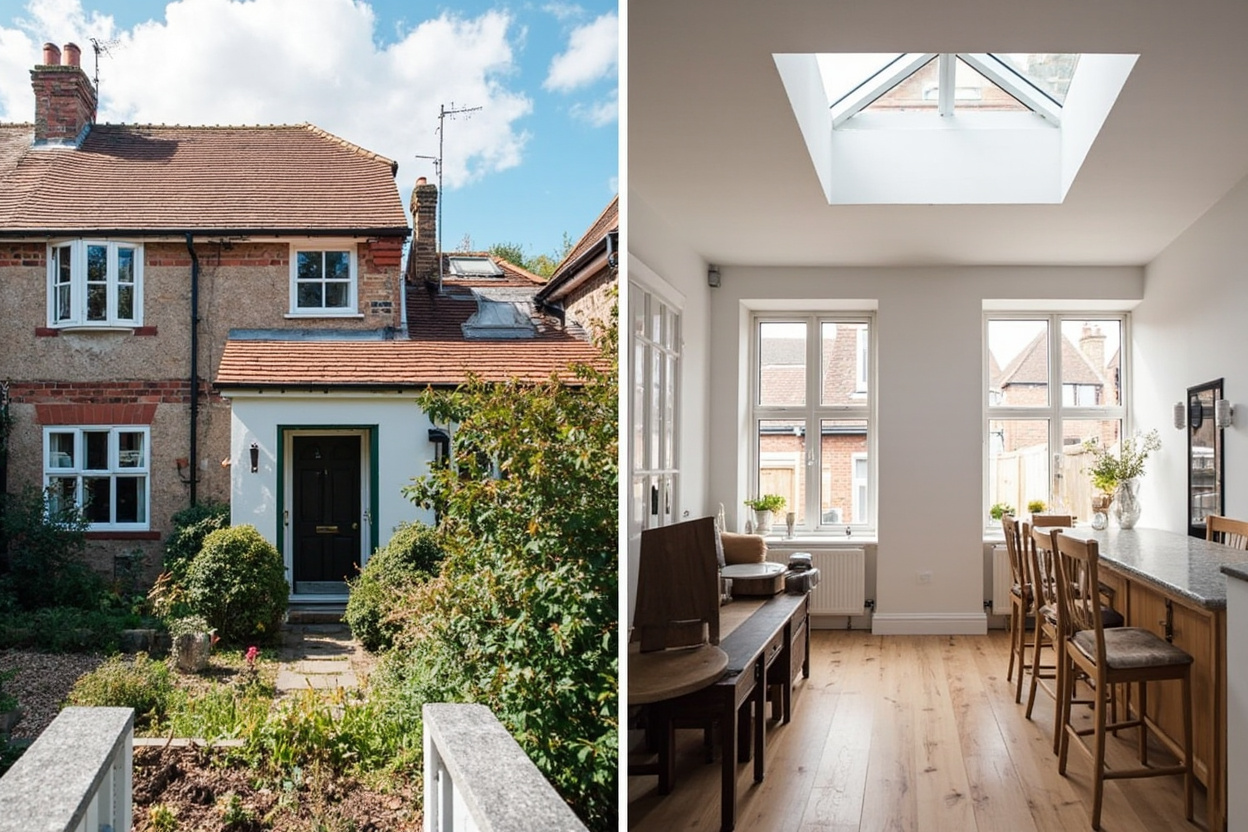
Two routes
Both options add space, but they solve different problems and the better-value route depends on what your home actually needs.
Comparison snapshot
The cheaper route is not always the better route
Extensions usually win for family living space. Lofts often win when you need another bedroom without losing the garden.
Remember
Compare the type of space created, not just the total bill.
Good next step
Run both calculators with your own scope before choosing a design direction.
Adding space to your home usually means choosing between building outwards or building upwards. A single-storey extension and a loft conversion are the two most common routes, and they solve fundamentally different problems. The right choice depends less on cost alone and more on what kind of space you need, what your house can accommodate, and how much disruption you can handle.
The core difference
An extension adds ground-floor space by building outwards — typically a larger kitchen or living area that opens onto the garden. A loft conversion adds upstairs space by converting what is currently just storage into a habitable room. Both add value, but they appeal to different motivations: more living space downstairs versus more bedrooms or a home office upstairs.
| Factor | Single-storey extension | Loft conversion |
|---|---|---|
| Typical total cost | £35,000–£90,000+ | £30,000–£75,000+ |
| Typical cost per m² | £2,200–£3,500+ | £1,800–£3,000+ |
| Disruption during works | High — site access, excavation, weather exposure | Medium — mostly internal, scaffold on roof |
| Planning permission | Usually required | Usually permitted under PD, some types need approval |
| Best for | Bigger kitchen, dining, living space; garden connection | Extra bedroom, en suite, home office; no garden loss |
| Impact on garden | Reduces garden size | No reduction |
When an extension wins
- You need genuine ground-floor family space — a kitchen that is too small for a growing household, a dining area that doesn't exist, or a living room that feels cramped. Extensions solve real functional problems that a loft simply can't.
- Your loft head height is poor (less than 2.2m at the highest point), which makes a loft conversion expensive or impractical. Some roof structures — trussed rafter roofs in particular — are very difficult to work around without major structural alterations.
- You want the strongest impact on day-to-day life. A well-designed extension that opens onto a garden can fundamentally change how a family lives, not just add another room.
- You are extending anyway for planning reasons — such as a side-return or part of a wider renovation — where the marginal cost of more space is reasonable.
When a loft conversion wins
- You mainly need another bedroom, a home office, or a guest suite and don't want to sacrifice garden space to get it. Lofts are ideal when you have enough upstairs volume to work with and don't need ground-floor expansion.
- Your roof is a traditional cut roof (not trussed rafters) or has sufficient volume to accommodate a conversion without significant structural work. A structural engineer can assess this quickly.
- You want to avoid the heavy disruption of a ground-floor build. A loft conversion is largely internal work — the site is less intrusive, and you can often continue living in the house while works proceed.
- You are looking for the best return on investment relative to cost. A well-executed loft conversion in a suitable property can offer excellent ROI, particularly in areas where additional bedrooms command significant premium.
What to factor in before deciding
The deciding factor for many homeowners is simply whether the existing loft can be converted at reasonable cost. If your roof is trussed rafters, or your head height is insufficient without major steelwork, the cost of a loft conversion can approach or exceed that of an extension — at which point the extension usually delivers more usable value.
Both options require proper planning and building regulations approval. An extension almost always needs planning permission and must comply with permitted development limits (size, height, positioning relative to boundaries). A loft conversion usually falls under permitted development rights but may require approval for specifics like dormer size, roof materials or the inclusion of a Juliet balcony. Always check with your local planning authority before committing to either route.
Run both calculators and compare the numbers with your own region and scope.
Quick answers for UK homeowners
Is an extension or loft conversion cheaper?
A loft conversion is often cheaper per project when the roof is suitable, but an extension may create more flexible ground-floor space.
Which adds more value?
It depends on the property, area and layout. Extra bedrooms can add value, while larger kitchens and living space can improve day-to-day usability.
Which should I price first?
Price both if your home can support either option. Compare cost, planning risk, disruption and the type of space you actually need.
Related planning pages
Country context for this guide
This page remains a UK-specific editorial guide so its existing search relevance is preserved. For US pricing, use the global project calculators and select a state and city. Browse calculators or review location coverage.
Editorial review
HomeProjects.money editorial team reviewed this page on 6 August 2026. This is a UK-focused page; US visitors should use a project calculator with a US location selected. Estimates are planning ranges and must be checked against a written local scope and quotations. Read the methodology.